All Fomo App Fees: Minimum Trading Charges Explained

If you’re considering trading on Fomo, one of the first things you probably want to know is simple: how much will Fomo actually take from my trade?
The answer isn’t quite as simple as saying “0.50%” because a lot more is involved.
First off, it is worth noting that Fomo does not have fixed trading fees. Its current terms state a 0.50% minimum fee per spot transaction, subject to a $0.95 minimum fee, while perpetual futures have a separate 0.05% fee per transaction.
It also states that third-party fees can apply and that Fomo’s fees can change. But there’s another important part of the story.
What this means is that the headline trading fee isn’t necessarily the same as your total cost of making a trade.
For example, FOMO may cover certain network-related costs such as gas fees, priority fees, and token rent, so you don’t have to pay those separately for every transaction. Its cross-chain setup can also reduce the need to manually bridge assets between networks.
For example:
- A $20 trade with a fixed $0.50 cost represents 2.5% of the trade.
- A $100 trade with the same $0.50 cost represents 0.5%.
- A $1,000 trade with that same $0.50 cost represents just 0.05%.
In other words, the larger your trade size, the smaller a fixed cost becomes as a percentage of your position.
That’s why you shouldn’t look at FOMO’s advertised fee alone. You want to consider the effective cost relative to your trade size, including any applicable trading fees, spreads and other costs.
What does this mean?
Simply put, the fee you pay doesn’t have the same impact on every trade. A small, fixed fee can eat up a significant percentage of a small position, while the same cost becomes almost negligible on a larger trade. This is why your effective trading costs can change considerably depending on how much you trade.
Here’s the full breakdown.
How Much Does Fomo App Charge?
For ordinary spot transactions, Fomo charges a minimum fee of 0.50% per transaction, subject to a minimum fee of $0.95. This applies to buy and sell transactions and can also apply to token swaps executed through third-party exchanges accessed through Fomo.
In practical terms, the $0.95 minimum is particularly important when you’re trading small amounts.
For example, if the applicable minimum is $0.95:
- A $20 trade would have an effective fee of 4.75%.
- A $50 trade would have an effective fee of 1.90%.
- A $100 trade would have an effective fee of 0.95%.
- At $190, $0.95 represents exactly 0.50%.
- A $200 trade at 0.50% would cost $1.00.
These calculations illustrate why saying simply “Fomo charges 0.50%” can give a misleading impression for smaller trades.
And remember that’s one side of the trade. If you buy and later sell, you’re potentially paying the applicable fee twice.
Why the $0.95 Minimum Matters
Imagine you’re trading a $20 memecoin position. At a straight 0.50% rate, the fee would only be $0.10. But if the $0.95 minimum applies, you’re actually paying $0.95.
That’s almost five times the cost of the simple 0.50% calculation.
This is one of the biggest things beginners miss when calculating whether a small memecoin trade is worthwhile.
If you’re putting $20 into a token hoping to make $5, a $0.95 entry fee plus another applicable fee when you exit can take a meaningful chunk of your potential profit.
What Has Fomo Said About the $0.10 Fee?
In one of the Fomo’s top executives while responding to a fee discussion on X, he clarified by saying that fee can be: “as low as $0.10 not 0.1%.”
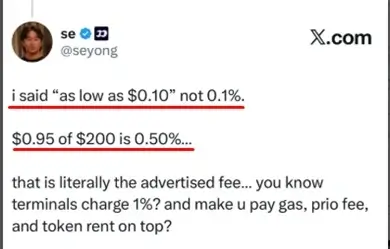
Clarifying a fee of $0.95 on a $200 transaction, describing that as approximately 0.50%.
Fomo has publicly stated that fees can be as low as $0.10, while the applicable fee for your specific transaction is what matters at the time you trade.
Does Fomo Charge Gas Fees?
Fomo says it covers certain gas fees, priority fees and token-rent costs on supported transactions. However, its terms also state that third-party fees may apply, so you shouldn’t assume every network-related cost is covered.
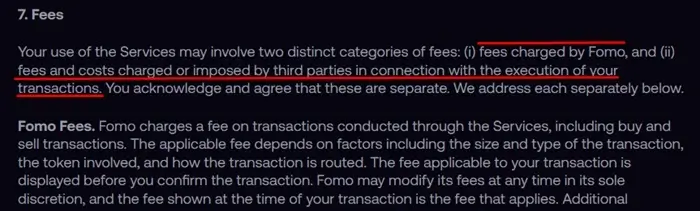
That’s significant because on-chain trading can involve more than the platform’s own trading fee.
For example, a trader may normally have to think about:
- Trading fees
- Blockchain gas
- Priority fees
- Token-account or token-rent costs
- Bridging costs
- Slippage
- Price impact
So don’t assume that every possible network or third-party cost is always covered.
Fomo uses lots of integrations so you can expect 3rd party fees. For instance, they use Perps by Hyperliquid and Trade [XYZ], Privy, Mercury, and etc.
What About Fomo Priority Fees and Token Rent?
Fomo has specifically mentioned priority fees and token rent alongside gas fees.
Token rent is particularly relevant on Solana because creating certain token accounts can involve an on-chain cost.
The important point for a trader is that these costs shouldn’t automatically be confused with Fomo’s trading fee.
Think of the transaction as having potentially different layers:
Fomo’s fee + network/third-party costs + slippage/price impact = your real trading cost.
If Fomo absorbs a particular network cost, that can reduce what you personally pay.
But if a third-party protocol or token imposes its own charge, that can still affect your transaction.
Does Fomo Charge Bridge Fees?
Fomo’s cross-chain functionality is another major part of the fee discussion.
Instead of manually moving assets from one blockchain to another, Fomo allows users to trade across supported chains without going through a traditional manual bridging process.
You remember those days when you had to fund Coinbase, send the funds to Uniswap, and swap them for ETH before you could buy memecoins? FOMO takes much of that complexity away.
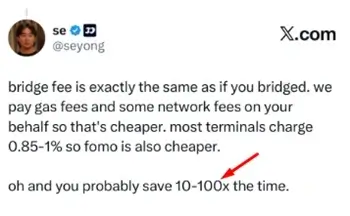
However, you want to note that the bridge fee is effectively the same cost associated with bridging yourself. What Fomo does is pay gas and certain network fees on your behalf.
In conclusion, you don’t necessarily have to manually bridge your assets before making a cross-chain trade through Fomo.
That’s a convenience benefit as much as a potential cost benefit.
Why Cross-Chain Trading Matters
Suppose your funds are on one network but the token you want to trade is on another.
Traditionally, you may need to:
- Bridge the assets.
- Wait for the bridge transaction.
- Pay the relevant bridge and network costs.
- Receive the assets on the destination chain.
- Connect to a trading terminal.
- Execute the swap.
Fomo’s approach is designed to simplify that process by handling the cross-chain transaction within the trading experience.
That’s why comparing Fomo only by its percentage trading fee can miss part of its value proposition.
From another perspective, if you are trading Robinhood chain tokens, the fees are higher. FOMO had to put a notice on its website so users know the fees upfront rather than assuming they are still part of FOMO’s standard fees.

So, the question, maybe isn’t just: What percentage does Fomo charge? but also, what does it cost me to complete this trade from start to finish?
Personally, I don’t look too much at the FOMO fees because what matters most to me is profitability. Luckily, there is a way to get cheaper trading fees. More on this as we go on.
Why Can a Fomo Swap Cost More Than Expected?
There are public complaints from Fomo users about transactions costing substantially more than expected.
One July 2026 post complained about Fomo charging $20–$30 for a swap.
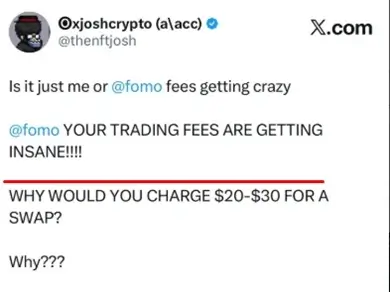
Another August 2026 post showed a user complaining about receiving approximately $380 worth of tokens after spending $400.
Those posts demonstrate something important: some users clearly perceive the final transaction cost as much higher than the headline percentage.
But they don’t prove that Fomo itself charged the entire difference as a trading fee.
For the first part, swapping money on Fomo is costly.
For instance, if you deposited Solana and you want to swap for USDC before trading, it is as follows:
- Under 5 USDC: 0.10 USDC
- 5–47.50 USDC: 2% of the swap
- 47.50–190 USDC: 0.95 USDC
- 190 USDC+: 0.50% – As of August 20, 2026.
So, for example:
- Swap $100 USDC → SOL → about $0.95 fee
- Swap $200 USDC → SOL → about $1.00 fee
- Swap $1,000 USDC → SOL → about $5.00 fee
What is the solution?
I’ve since stopped swapping on FOMO. What I do instead is swap my assets to USDC on the crypto exchange I use, then send the USDC to FOMO and trade without needing to swap again.
Doing this can help you avoid the additional swap-related fees mentioned above.
Want to see how? – check out how to fund/deposit money on Fomo App.
For the second part – final transaction cost as much higher than the headline percentage.
The truth is that the final difference potentially involves several factors, including:
- Fomo’s applicable trading fee
- Minimum fees
- Slippage
- Price impact
- Token liquidity
- Network or third-party costs
- Token-specific contract fees
- The actual execution price
So, if you see a large difference between what you spend and what you receive, don’t automatically label the entire difference “Fomo fees.”
Fomo Fees vs Slippage: They’re Not the Same Thing
This distinction is extremely important when trading memecoins.
Suppose you enter a token with $100.
You might see: $100 order → $0.95 Fomo fee → approximately $99.05 remaining
But your actual token position could still be worth less than $99.05 immediately after execution.
Why?
Because the token may have:
- High price impact
- Low liquidity
- Significant slippage
- A rapidly moving market price
That loss isn’t necessarily a Fomo trading fee.
This is why I recommend looking at the estimated output and execution details before confirming a trade instead of judging the cost solely from the amount you entered.
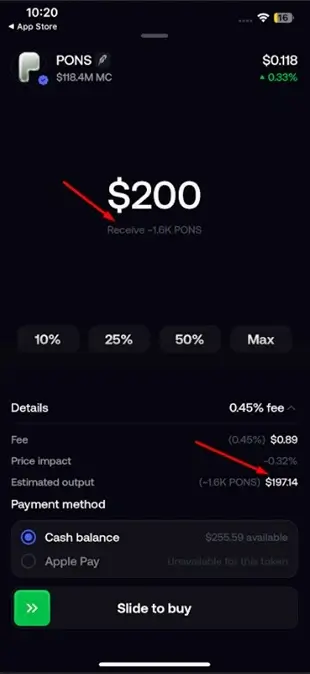
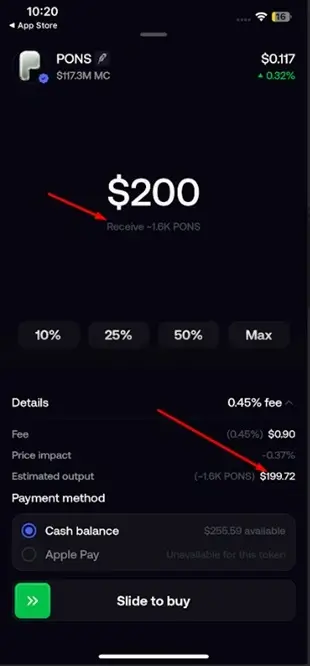
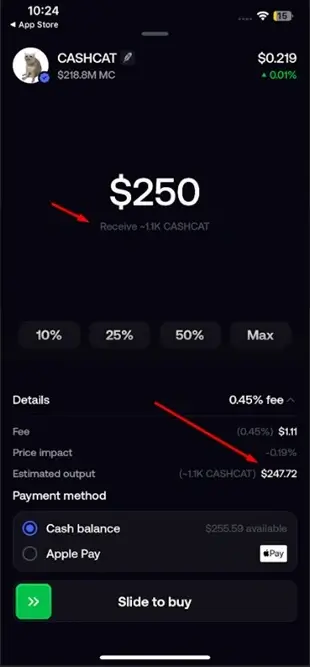
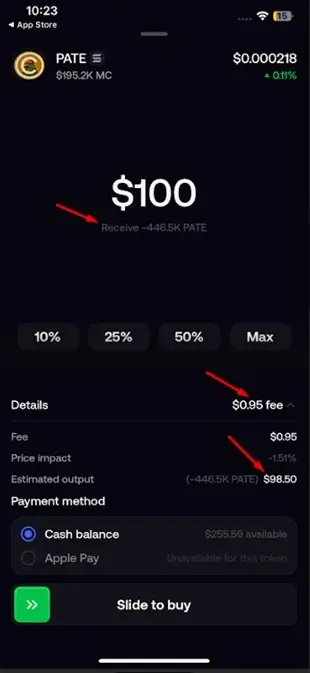
Therefore, the larger your transaction becomes, the less impact a fixed minimum has on your percentage cost.
This doesn’t mean you should blindly increase your position size to reduce fees. Risk management comes first.
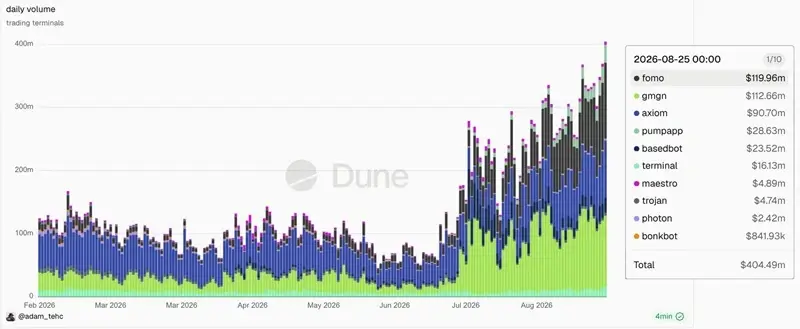
What an analysis of Fomo wallets found
An independent audit of roughly 467,000 FOMO wallets (widely shared on X in mid-2026) put numbers out. The findings:
- Nine out of ten wallets trade under $190 per transaction.
- Those small-trade wallets move about a quarter of total volume on the app but pay more than half of all fees collected.
- Every one of the ten largest fee-paying wallets gets the full 0.50% advertised rate.
- The worst effective rates in the dataset 4% to 8% belong to people trading roughly $2 at a time.
Broken down by wallet size, the fee burden looks like this:
How to Avoid Overpaying on FOMO
One of the best ways is to batch smaller trades into larger ones where possible.
Three $10 trades cost roughly $2.85 in fees combined, while one $30 trade at the $0.95 minimum costs about a third of that.
All in all, you want to avoid unnecessary tiny transactions when your strategy allows it.
Fomo Trading Fees vs Other Trading Terminals
Fomo has publicly argued that some competing terminals charge around 0.85%–1%, and has claimed that Fomo can be cheaper.
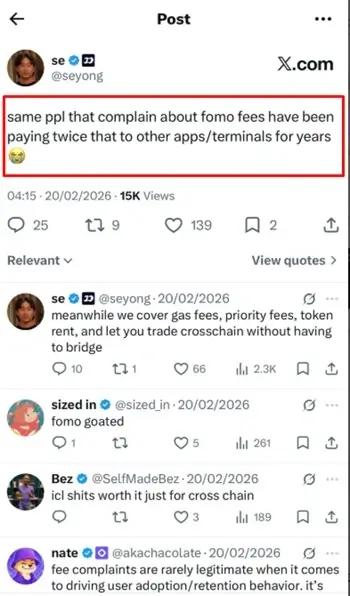
It has also stated that users who complain about Fomo fees may already be paying more elsewhere.
While those are Fomo’s own competitive claims, not an independent fee comparison, you can still do independent research and compare: same token + same trade size + same network + same execution conditions + same time. Then compare the actual amount received.
Nonetheless, there is still a way to get cheaper trading fees on the FOMO App. Read on.
Where Fomo is Actually Cheaper
For larger trades, a 0.50% trading fee is relatively straightforward to calculate.
But for smaller trades, the minimum fee can make the effective percentage significantly higher.
That’s why I’d describe Fomo as potentially cost-effective depending on your trade size and transaction, rather than simply calling it “cheap.”
There are also convenience benefits that don’t show up in the headline percentage, particularly Fomo’s cross-chain trading experience and its stated coverage of certain network-related costs.
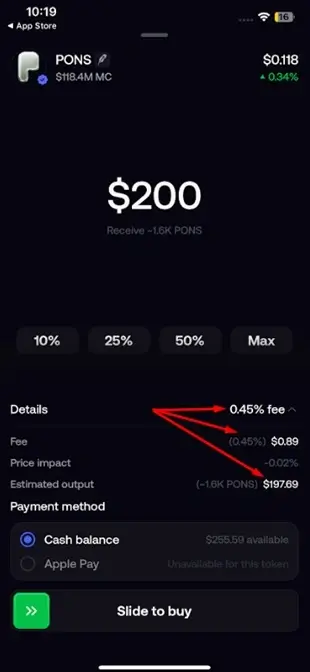
At the same time, you should not ignore the complaints about expensive swaps. As I said earlier, the right approach is to check the actual transaction cost shown [by opening the fee knob section] before confirming every trade.
What About Fomo App Perpetual Futures Fees?
Perpetual futures are a separate product from ordinary spot trading, and they are cheaper than Fomo Spot, hence its popularity, and success.
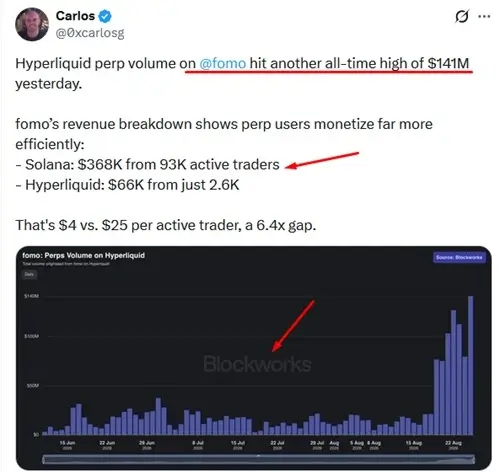
Fomo currently charges 0.05% per perp transaction, in addition to fees charged by applicable third-party protocols, including trading fees, gas fees and funding-rate payments.
This means you shouldn’t use the 0.50% spot figure when calculating the cost of a Fomo perpetual position.
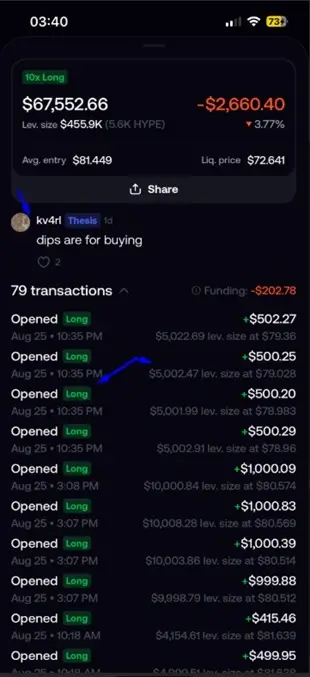
For leveraged trading, those additional costs can matter considerably because you’re trading in a larger notional position.
And you also need to consider the third-party venue and funding costs.
Does Fomo Offer Cashback on Trading Fees?
I couldn’t find evidence in the material reviewed for a separate cashback program. Fomo’s referral offer is a trading-fee discount rather than cashback.
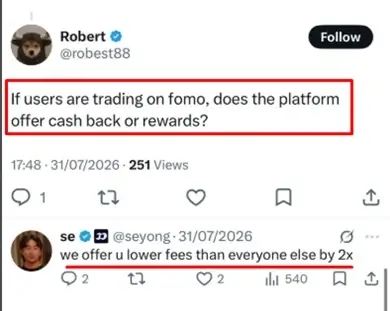
When a user asked this, the co-founder responded by saying,
“We offer u lower fees than everyone else by 2x”.
That is a fee-reduction claim, not confirmation of a cashback program. So, no, there is no cashback. What you get instead is a trading fee discount. See below.
Can You Reduce Your Fomo Trading Fees?
FOMO’s standard trading fee is 0.50%. Now, to get a reduced trading fee and discounts, you will have to sign up on Fomo through a referral link.
This reduces your fee to 0.45%, with the discount applied automatically to every trade.
Fomo also offers referral-based fee discounts for eligible new users. Because the discount and signup process are covered in detail on our dedicated referral guide, see Fomo App Referral Code for the current code and instructions.
Howweverrk, if you want to get a reduced fee from 0.50% to 0.45% on all trades, you can get started here.
Yet to create a Fomo account? Here’s how to sign up in 1 minute.
Alternative ways to Reduce Fomo Trading Costs
If you’re actively trading on Fomo, there are several practical ways to avoid unnecessarily high effective costs.
1. Understand the minimum fee
Don’t assume a $20 trade costs 0.50%. Check the actual fee shown before confirming.
2. Avoid excessive tiny trades
If you’re constantly entering $10–$20 positions, a fixed minimum can consume a much larger percentage of your capital.
3. Check estimated output
Before confirming a swap, look at what you’ll actually receive. Don’t judge a trade purely by the amount you’re entering.
4. Watch slippage and liquidity
A cheap trading fee doesn’t rescue a trade with terrible liquidity. A token can have a low platform fee but still give you a poor execution price.
5. Account for both entry and exit
Your trading cost isn’t just the buy fee. If you buy and later sell, you’re potentially paying another applicable transaction fee.
6. Use a referral discount if you’re eligible
When calculating your actual trading result, account for entry fees, exit fees, slippage and other applicable costs-not just the token’s price movement.
This is why your actual P&L should be calculated as: Entry + Exit + Slippage + Fees = Actual P&L
For memecoin trading profit calculations, there is a free calculator you can use.
How to Check Your Fomo Fee Before Trading
1. Enter the token and amount you want to trade.
2. Review the transaction details before confirming.
3. Check the applicable fee.
4. Check the estimated amount of tokens you’ll receive.
5. Consider the price impact and slippage.
6. Compare the expected output with your intended trade size.
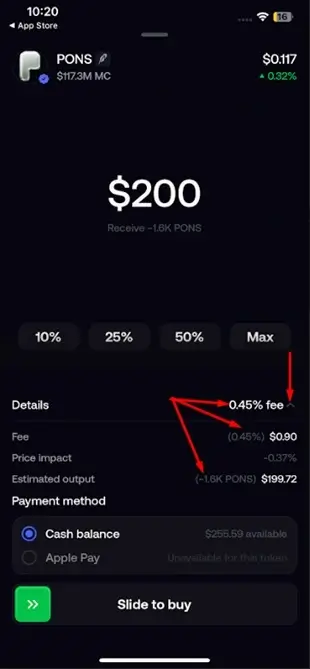
7. Only confirm the transaction when you’re comfortable with the final numbers.