63 Memecoin Trading Terms in English: Beginner’s Glossary

If you have ever landed in a crypto Telegram group, scrolled through Crypto Twitter, or tried to follow a memecoin discussion and felt like everyone was speaking a different language – you are not alone 👉👈
Memecoin culture has developed its own vocabulary over the past decade, a mix of internet slang, trading jargon, inside jokes, and hard-earned lessons from people who have been rekt more than once.
And so, understanding this language is not optional if you want to participate meaningfully in memecoin markets.
For instance, when someone warns you “this looks like a rug,” you need to know they are not talking about your living room floor. When CT starts saying “we’re so back,” you need to understand the emotional context before you make any financial decisions based on that energy.
And when someone shares a CA and asks you to check the market cap and holders, you need to know exactly what to look at and why it matters.
Gracefully, this guide covers every major memecoin term, from community slang to technical fundamentals, with plain English explanations and practical examples drawn from real trading conversations.
By the time you finish reading, you will understand every message in any memecoin community without needing to ask what anyone means.
Let’s start with some less slang-heavy terms before we get into the fun of the full-on trenches slang.
Blockchain & Technical Memecoin Trading Terms
Before you learn the slang, you need to understand the basic technology underneath a memecoin trade.
1. Blockchain
A blockchain is a decentralized digital ledger that records cryptocurrency transactions and other data.
See it this way. A blockchain is like a public notebook that records every crypto transaction ever made.
Each page (block) stores transactions.
Now, imagine your classroom has one notebook sitting on the teacher’s desk.
Whenever someone sends money to another student, everyone watches the teacher write it down.
Nobody can secretly erase or change what’s already written because everyone has a copy of the notebook.
That’s basically how a blockchain works.
Instead of one notebook, thousands of computers around the world keep identical copies.
Example
James sends: 5 SOL to Sarah.
The blockchain records:
- Sender: James
- Receiver: Sarah
- Amount: 5 SOL
- Time: 10:05 AM
Thousands of computers verify it, processed and recorded on the Solana blockchain.
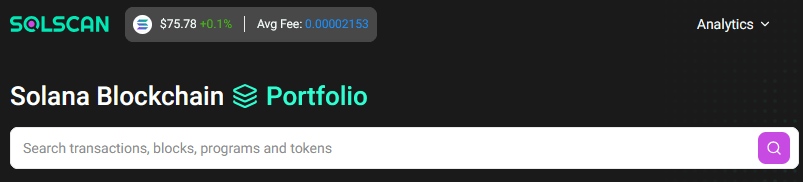
Now everyone agrees that the transaction happened. And you can then use a blockchain explorer to inspect the transaction.
That’s why crypto doesn’t need a bank.
In simple terms: Blockchain = the network where the crypto activity happens.
2. Smart Contract
A smart contract is a program stored on a blockchain that automatically carries out actions according to rules written into its code.
Tokens, decentralized exchanges, liquidity pools and other crypto applications can rely on smart contracts.
Simple example
When you swap SOL for a memecoin, a smart contract can handle the transaction according to its programmed rules.
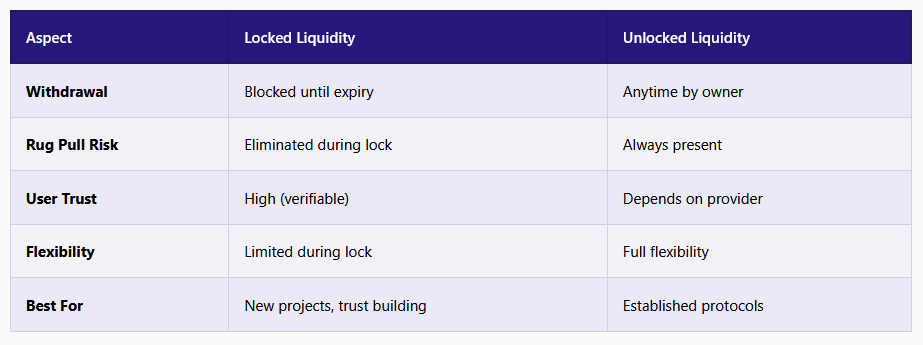
You’ll also hear people talk about locked liquidity.
When liquidity is locked, the funds in a liquidity pool are placed under conditions that restrict when or how they can be withdrawn.
This is why smart contracts matter when you’re researching a new token.
A smart contract isn’t automatically safe just because it exists. The permissions and functions built into it can matter.
3. Gas Fees
Gas fees are transaction costs paid to a blockchain network to process certain transactions.
You’ll hear this term particularly often when discussing Ethereum.
Example
“The gas fee was too high, so I didn’t make the trade.”
The trader means the cost of processing the blockchain transaction was too expensive.
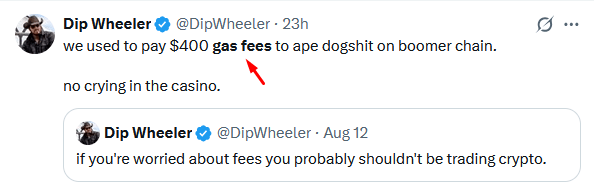
On Solana, transaction costs are generally much lower than on Ethereum, which is one reason Solana is popular for fast-moving token trading.
4. Gas Wars
A gas war happens when users compete to get their transactions processed before others by offering higher transaction fees.
This can happen during highly anticipated launches or NFT mints.
Example
Thousands of people try to buy or mint something at the same time.
Some increase the transaction fee they’re willing to pay to improve their chances of being processed first.
That’s a gas war.
Token & Project Memecoins Trading Terms
These terms help you understand what you’re actually buying.
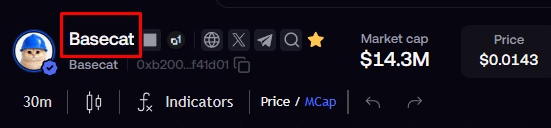
5. Token Name
The token name is simply the name given to a cryptocurrency.
For example:
- PEPE
- CashCat
- BONK
- SHIB
A token also normally has a ticker symbol, which is the shorter version used on charts and trading platforms.
Example
“The token is DogWifHat and the ticker is WIF.”
The important thing is not to rely on the name alone.
Scammers can create tokens with identical or very similar names.
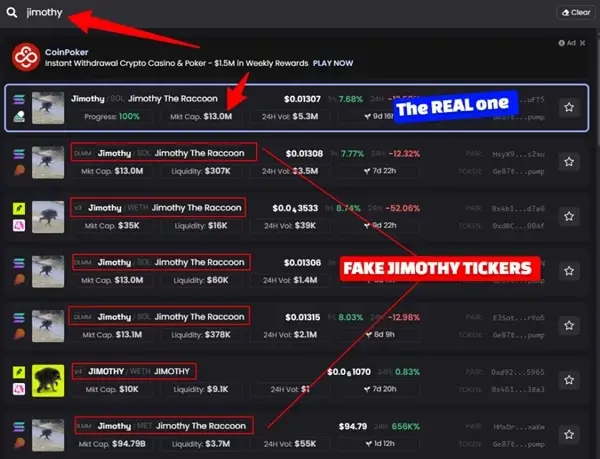
That’s why you should verify the contract address – you learn this and more on Rektocracy – memecoins trading for beginners.
6. Contract Address (CA)
If you go on Twitter, you will see CA a lot. CA means Contract Address.
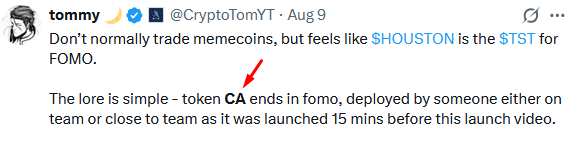
It is the unique string of letters and numbers identifying a specific token contract on a blockchain.
Example
Someone says: “What’s the CA?”
They’re asking: “What’s the contract address for the exact token you’re talking about?”
This is important because multiple tokens can have similar names.
In practice, don’t search for a token solely by its name and assume you’ve found the correct one.
Verify the contract address using an official project source or a trusted blockchain/token platform.
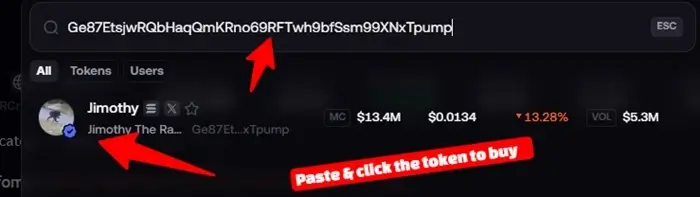
The CA identifies the specific token.
7. Launchpad
A launchpad is a platform that helps new cryptocurrency projects launch their tokens.
Depending on the platform, it can provide tools for token creation, distribution, fundraising or early access.
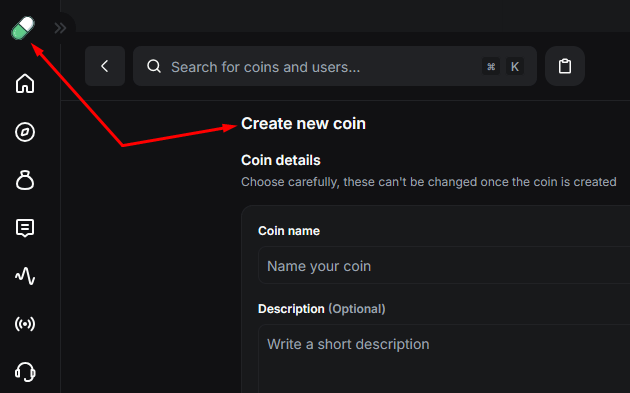
Real Example
A new memecoin launches through a token launch platform – like Pump.fun. Puns, etc.
Traders discover it there before it becomes widely traded elsewhere.
A launchpad can provide useful information about a project, but being launched through a launchpad does not automatically make a token safe.
You still need to research the token, liquidity, holders and other risks.
8. Mint
To mint means to create a new digital asset on a blockchain.
The term is particularly common with NFTs [decrypt.co], although minting can also refer to the creation of new tokens.
Real Example
An NFT project announces: “Mint starts at 12 PM.”
At that time, users interact with the relevant blockchain application to create or acquire the NFTs.
That process is called minting.
9. Floor Price
The floor price is the lowest listed price for an NFT in a particular collection.
Real Example
If the cheapest NFT currently listed in a collection costs 0.5 SOL, the collection’s floor price is 0.5 SOL
If someone lists one for 0.4 SOL, the floor price becomes 0.4 SOL.
Memecoins Market & Valuation Trading Terms
These terms help you understand how big a token is and how its market is behaving.
10. Market Cap
Market cap, short for market capitalization, represents the approximate value of a cryptocurrency’s circulating supply.
A simplified formula is: Market Cap = Token Price × Circulating Supply
Real Example
Imagine a token has 1 billion circulating tokens and each token is worth $0.001
Its market cap would be: $1 million.
This is why token price alone can be misleading.
A token priced at $0.000001 isn’t automatically “cheaper” than one priced at $0.10.
You need to look at the supply and market cap.
Why memecoin traders care about Market cap
Market cap also gives you a way to think about potential multiples.
For example: $500,000 → $50 million would represent a theoretical 100X market-cap increase, assuming other relevant factors remain comparable.
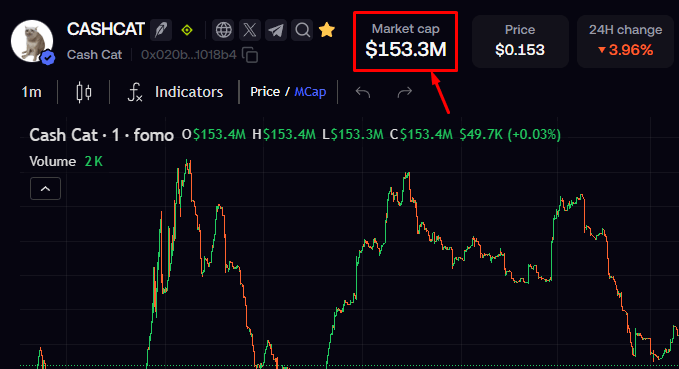
But a low market cap doesn’t automatically mean a token is a good opportunity.
It can also mean the token is extremely risky – Rug pull worthy.
If you’re trading memecoins, you can use a memecoin profit calculator to estimate your potential P&L while also taking the token’s liquidity pool into account.
This gives you a more realistic idea of how much profit you could potentially make, and, importantly, how much of that profit you may actually be able to realize when you sell.
11. Holders
Holders refer to the wallets currently holding a token.
You may see a token described as having: 5,000 holders or: 20,000 holders
This tells you how many wallet addresses are recorded as holding the token, depending on how the platform counts them.
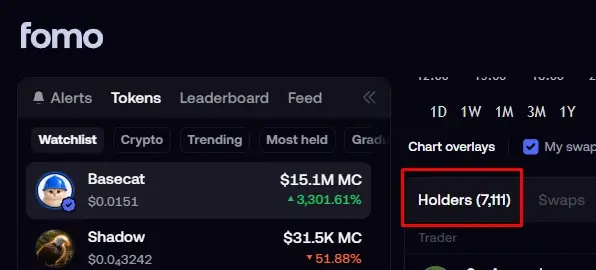
But don’t stop at the number. Holder distribution matters.
Imagine two tokens both have: 10,000 holders
Token A: The largest wallets hold relatively small portions of the supply.
Token B: The top few wallets control a huge percentage of the supply.
Those are very different situations.
A token can have thousands of holders and still have highly concentrated ownership.
Real Example
“Check the holders. The top 10 wallets control 60% of the supply.”
That’s a warning that a relatively small number of wallets may have significant influence over the token.
If you’re using Fomo trading app, I’ve explained how to use the platform and what certain liquidity and price-impact percentages can indicate when assessing the risk of a potential rug pull.
12. Whale
A whale is a wallet holding a sufficiently large amount of a cryptocurrency to potentially influence its price through its own buying or selling.
The exact amount required to be considered a whale depends on the token and its liquidity.
Example
A small memecoin has: $50,000 liquidity
One wallet holds a very large position.
If that wallet suddenly sells a significant amount, it could have a major effect on the price. That’s a whale.
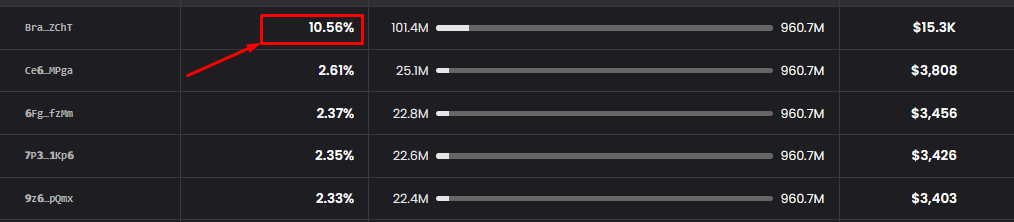
Why whales matter
When researching a memecoin, you should look beyond the number of holders and examine how the supply is distributed.
A wallet holding a large percentage of supply can create significant concentration risk.
Liquidity & Memecoins Trading Terms
Market cap tells you one thing. Liquidity tells you something very different.
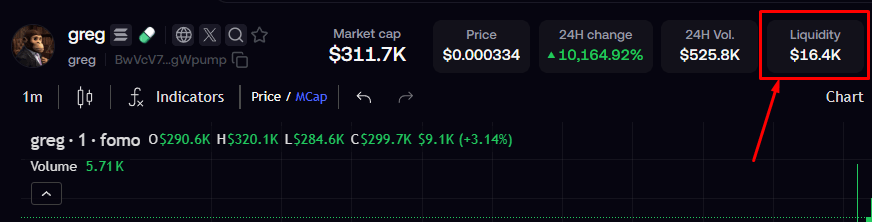
13. Liquidity
Liquidity refers to the funds available to facilitate buying and selling without causing extreme price movements.
Example
Consider two tokens:
Token A
Market cap: $1 million
Liquidity: $500,000
Token B
Market cap: $1 million
Liquidity: $20,000
They have the same market cap.
But their trading conditions can be completely different.
A large order relative to Token B’s available liquidity could cause much greater price impact.
In simple terms – Market cap tells you how much the token is theoretically worth. Liquidity tells you how much trading capacity is available.
That’s why you should check liquidity before entering a low-cap memecoin.
14. Liquidity Pool
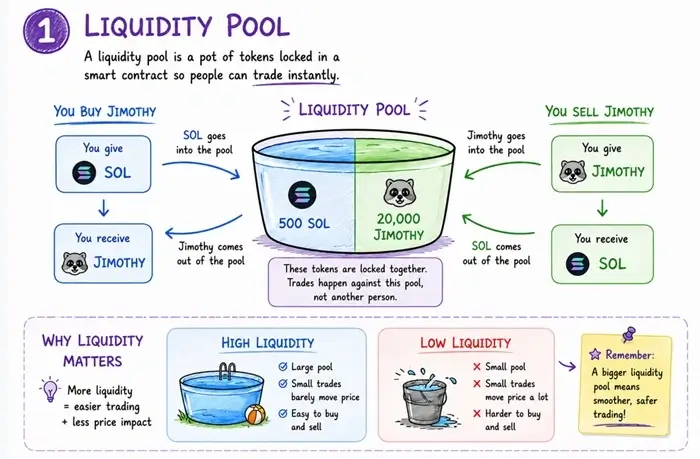
A liquidity pool is the pool of assets used to facilitate decentralized trading.
For example, a pool could contain a memecoin paired with SOL.
Instead of buyers and sellers being matched through a traditional order book, trades interact with the assets held in the pool.
Example
A memecoin has a liquidity pool containing: MEME + SOL
You buy MEME using SOL.
Your transaction interacts with that pool.
Why it matters
If the pool is small relative to your trade, your transaction can have a larger effect on the execution price.
This is known as price impact.
15. Locked liquidity
You may also hear: “Liquidity is locked.”
This generally means the liquidity has been placed under conditions designed to prevent the relevant funds from being withdrawn for a specified period.
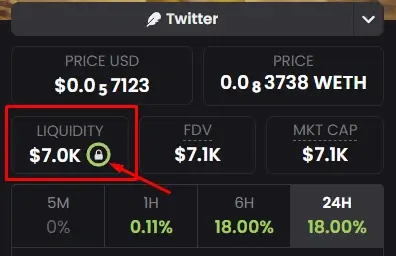
Unlocked liquidity can be an important warning sign when evaluating a new memecoin.
16. Exit Liquidity
Exit liquidity refers to buyers who enter a market while earlier investors are using the new demand to sell their positions.
Real Example
A token pumps.
Early buyers decide to take profits.
New traders see the green candles and rush in because they don’t want to miss the move.
Those new buyers provide the demand that allows earlier holders to exit.
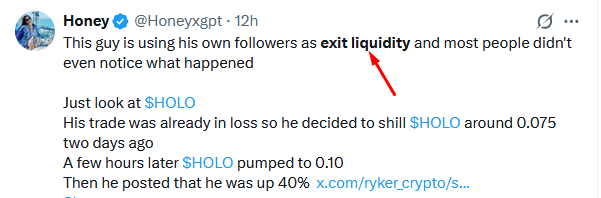
Someone might warn: “Don’t become exit liquidity.”
In other words: Don’t be the person buying while earlier traders are using that demand to sell.
17. Bag
A bag simply means the cryptocurrency or token position you’re holding.
Example
“I’ve got a small bag of this token.” That means: “I currently hold a small amount of this token.”
You might also hear: “I added to my bag.”. That means the person bought more.
18. Bagholder
A bagholder is someone who continues holding a token after its price has collapsed.
Real Example
You buy near the top. The token falls 90%. You continue holding because you don’t want to sell at a loss.
You may now be called a Bag holder. You’ve now become part of the token community of long-term holders 🤭
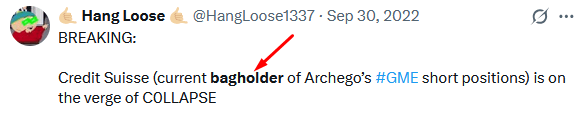
The term is usually used jokingly, but the underlying situation can involve a serious loss.
The Chart Trading Language
Once you start looking at memecoin charts, you’ll see these terms everywhere.
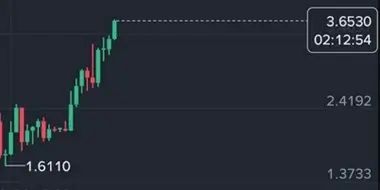
19. Green Candle
A green candle generally means the price closed higher than it opened during the selected timeframe.
Example – A token opens at: $0.001 and closes at: $0.0015
You’d generally see a green candle.
20. Red Candle
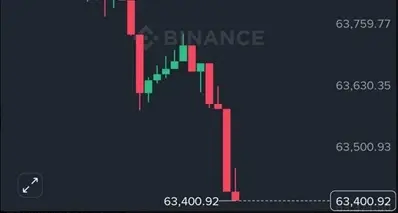
A red candle generally means the price closed lower than it opened during the selected timeframe.
Example – A token opens at: $0.001 and closes at: $0.0008
You’d generally see a red candle.
In simple terms
Green = price closed higher
Red = price closed lower
21. Moon / To the Moon
When traders say a token is mooning, they mean its price is rising dramatically.
Example – A token moves from: $100,000 market cap → $1 million
Someone might post:
“It’s MOONING 🚀”
“To the moon” is the aspirational phrase traders use when they expect a token to keep rising.
22. Send It
When traders say Send it, it means, let’s go make the token moon/surge.

23. NGU
NGU means: Number Go Up.
It’s a humorous way of expressing the belief or hope that cryptocurrency prices will continue rising.

Example – “Forget the FUD. NGU.”
They’re basically saying: “The number is going up.”
It can be used seriously, but it is often sarcastic.
24. Pump It
Pump it is a humorous request for a token’s price to increase.
Example – A community is watching its token move sideways. Someone posts: “Come on, pump it!”
They’re hoping for the price to start moving upward.
Memecoins Trading Behavior & Strategy Terms
These terms describe how people behave when trading.
24. Ape/Ape In
To ape into a token means to buy it quickly, usually with little research, because you’re excited about the opportunity or afraid of missing the move.
Real Example – A new token starts pumping.
You see people posting about it.
Without checking the contract, holders or liquidity, you immediately buy $100.
You just: Aped in.

The phrase doesn’t necessarily mean the trade will fail.
It describes how you entered.
25. Degen
Degen is short for “degenerate.”
In crypto, it describes someone who willingly embraces highly speculative and risky trades.
Example – “That’s a degen play.”
Translation: “That’s an extremely speculative trade.”
Some traders use “degen” almost as a badge of honor.
The important thing is to understand the risk you’re taking.
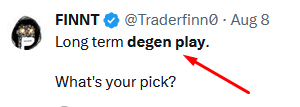
26. Degen Play
A degen play is a highly speculative trade with potentially huge upside and a high probability of failure.
Real Example – A brand-new token launches.
It has little history and very limited information.
You put $20 into it knowing you could lose the entire amount.
That’s a: Degen play.
A degen play should never be confused with a low-risk investment.
27. YOLO Trade
YOLO means: You Only Live Once.
A YOLO trade is an extremely aggressive trade made with little risk management.
Real Example – You have $1,000.
You put the entire $1,000 into one brand-new memecoin because you believe it could 100X.
That’s a YOLO trade.
It could produce a huge return.
It could also wipe out your position.
It is always a 50/50 game.
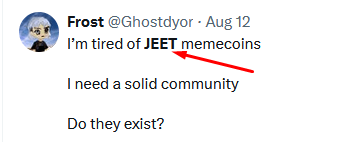
28. Jeet
A jeet is someone who sells a cryptocurrency very quickly, often taking a small profit before the token makes a larger move.
The term is usually used mockingly.
Real Example – A token pumps 10%.
You immediately sell. The token then pumps another 300%.
Someone might say: “You jeeted too early.”
But here’s the funny part: Sometimes the person who sold for 10% was right.
The token might have dumped immediately afterward 😁
So “jeet” is a community judgment, not proof that selling was a bad decision.
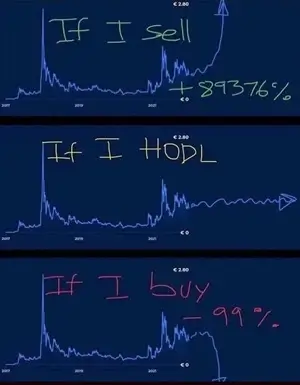
29. HODL
HODL means holding your cryptocurrency through market volatility instead of selling because of short-term price movements.
The word became famous after a misspelling of “hold” turned into a crypto meme.
Real Example – “I’m not selling during this dip. I’m going to HODL.”
It means: “I’m holding.”
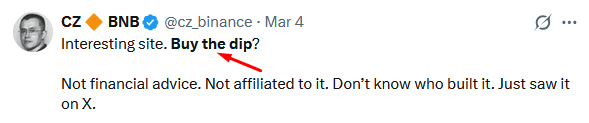
30. Buy the Dip
Buy the Dip means purchasing an asset after its price has fallen because you believe the decline is temporary.
Real Example – A token falls: $1 → $0.70. You believe it will recover and buy.
“I’m buying the dip.” But remember: A dip isn’t automatically a bargain.
Sometimes a dip continues falling.
31. BTFD
BTFD means: Buy The Freaking Dip.
It’s a more emphatic version of “Buy the Dip.”

Real Example – The market suddenly falls.
Someone posts: “BTFD.” They’re encouraging people to buy the decline.
I mooned $31K.
Then rekt back to $2K.
Rektocracy is the memecoin guide I wish someone had handed me before my first ape. Get it free, plus the weekly FOMOByte rundown on what's actually moving.
- Entry rules for 8 real trade setups — from launchpad plays to KOL-linked pumps
- The exact exit mistakes that gave back $35K+ in paper gains
- A wallet-security checklist so one hack doesn't erase the win
One email a week. No spam. Unsubscribe anytime.

Emotional Trenches Trading Terms
Memecoin trading can trigger some very strong emotions.
These terms describe them.
32. FOMO
FOMO means: Fear of Missing Out.
It’s the feeling that everyone else is making money while you’re sitting on the sidelines.
Fomo means so many things. Fomo bytes, hence, fomobyte.com, Fomo trade – from FOMO family trading platform. Fomo makes you ape in and jeet.
FOMO is just a wonderful concept and 🐐 in the trenches.
Real Example – A token pumps 500%. You see traders posting screenshots of their profits.
You start thinking: “If I don’t buy now, I’ll miss the next 500%.”
So you buy. That’s FOMO.
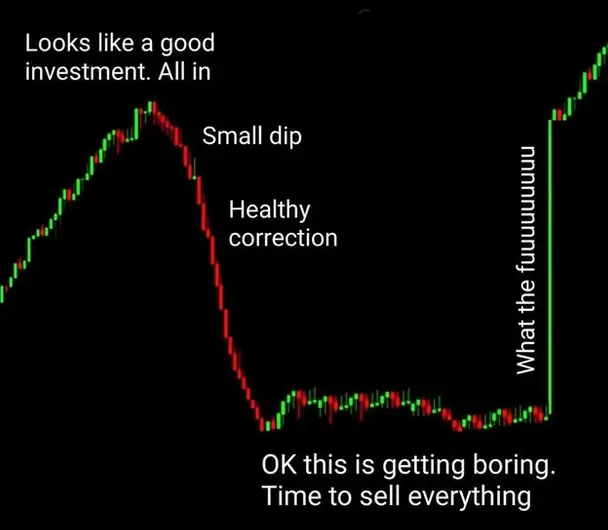
The danger is that you’re entering because of emotion rather than a well-thought-out plan.
33. Diamond Hands
Diamond hands describes someone who continues holding through extreme volatility rather than selling because of fear. I mean, we’ve all been there at one time because we wanted to make more.
My recent narrative tests have taught me to sell when the narrative starts to fade. I don’t care if the token pumps again afterward.
As long as I’ve secured my profits, I’m good.
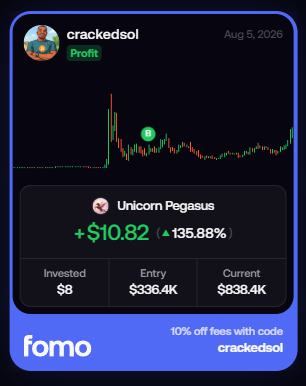
Real Example – the token you aped falls 40%. You remain calm and reassess your original reason for buying.
If your thesis still makes sense, you continue holding. Someone might say: “You’ve got diamond hands.”
34. Paper Hands
Paper hands is the opposite.
It describes someone who sells quickly because of fear or short-term price movement.
Real Example – You buy a token. It falls 10%. You panic and sell.
Someone says: “Paper hands.”
This is how I missed out on a profitable trade that eventually did a 100× months ago, before I started trading narratives.
I aped in at a $48K market cap and sold it when the token dropped to around $43K.

But the token didn’t stop there. It later surged all the way to around $430K market cap.
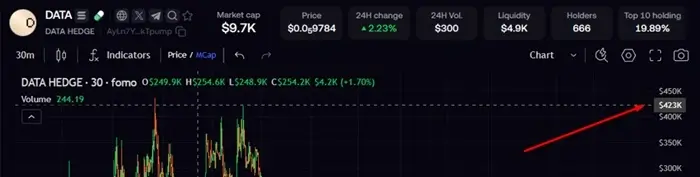
Wondering how much I would have made if I hadn’t sold? Let’s find out.
We’ll head over to the FomoByte Solana Calculator and enter the trade details.
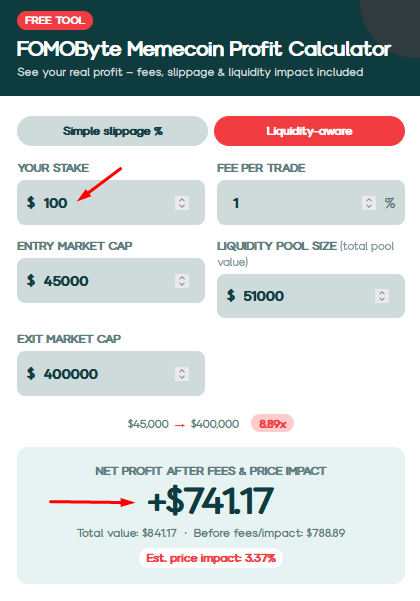
Now, imagine if I had understood narrative trading back then. I probably would have invested around $1,000 and held through the dip, because the token had a strong AI-related narrative.
If I had done that, the calculator shows I could have made $7,000+ in profit.
Of course, this is a what-if scenario. Nobody knows in advance whether a token will recover after a major dip. The lesson for me was simply that understanding the narrative can help you decide when a temporary pullback is worth holding through-and when the narrative has genuinely faded.
Want to get access to the memecoin calculator? Get it for Free 💥
35. Diamond Hands vs. Paper Hands War
This is the humorous battle between people who hold through volatility and people who sell quickly.
Diamond hands: “I’m holding.” 🤏
Paper hands: “I’m out.” 😒
You’ll often see this phrase used during major price swings.
But remember: Holding isn’t automatically good, and selling isn’t automatically bad.
What matters is whether your decision follows a sensible plan – or a trading narrative.
36. Bull Market Brain
Bull market brain describes the overly optimistic mindset that can develop when prices are rising for a long period.
When everything you buy seems to go up, you may start believing: “This one can’t go down.”
That’s bull market brain.
It can cause traders to take much more risk than they normally would because recent gains make the market feel safer than it actually is.
Risk & Loss Terms
These are some of the most important terms to understand before trading a new memecoin.
37. Rekt
Rekt means: Wrecked.
In crypto, it means suffering a major financial loss.
Real Example – You invest: $1,000
The token crashes. Your position is now worth: $100
You might say: “I got rekt.”
It can describe a single bad trade or a much larger portfolio loss.
38. Getting Rekt
Getting rekt simply means suffering a major financial loss.
Real Example – “Anyone who bought the top got rekt.”
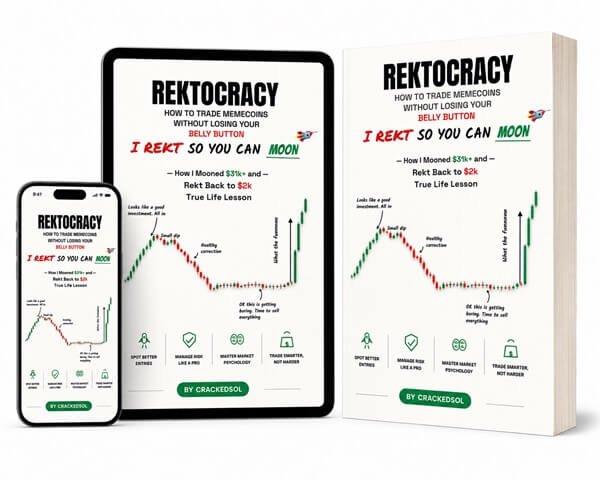
Want to see what getting Rekt really feels like – the pains?
Check out my trading guide, where I break down how I invested $4,000+, grew it to as much as $31K, and eventually lost it all.
39. Rug Pull
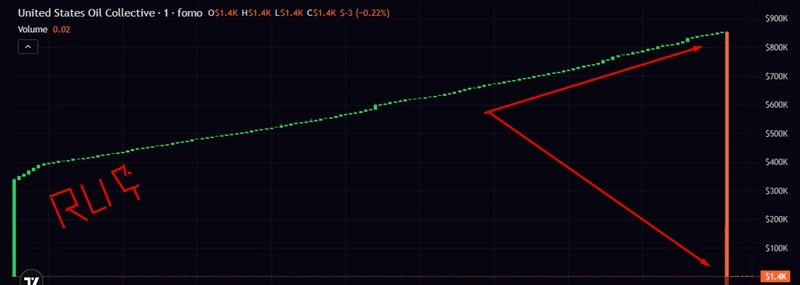
A rug pull happens when a token’s creator or major holder drains liquidity or dumps a large token position, causing the price to collapse.
Real Example – You buy a new memecoin.
The chart looks great. Then a major wallet sells heavily or liquidity is removed.
The price collapses. You may have been: Rugged.
Things traders watch for
When researching a new token, traders often look at:
- Liquidity
- Holder concentration
- Large wallets
- Developer wallet activity
- Whether liquidity is locked
- The token contract
- Whether the project is creating artificial urgency
A token can have a great-looking chart and still be extremely risky.
40. Bogged
To get bogged means buying a token immediately before its price crashes. The real definition of being unfortunate in the trenches 😫
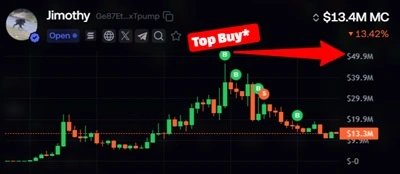
Real Example – You see a massive green candle. You buy at the top.
A whale sells immediately. The token crashes.
“I got completely bogged.”
41. Rug Pull Survivor
A rug pull survivor is someone who has lost money in a failed or fraudulent crypto project but remains active in the crypto space.
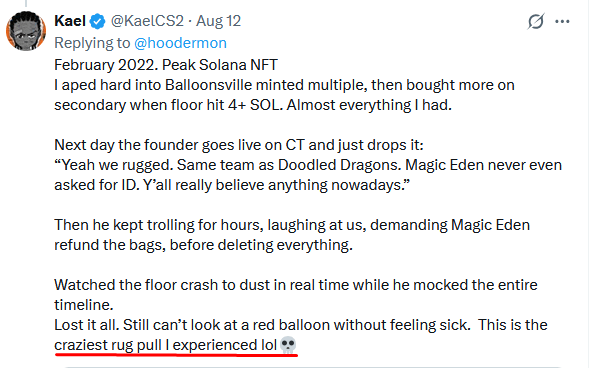
Example – “I’ve survived three rugs. Each one taught me something.” It’s usually worn as a humorous badge of experience.
42. LARP
LARP means Live Action Role Play.
In crypto slang, it describes someone pretending to be something they’re not or creating a false story to generate hype, attention or money.
Real Example – Someone claims:
“I’m a developer insider. This token is guaranteed to 100X.”
But they have no legitimate connection to the project.
Someone might say: “He’s LARPing.”
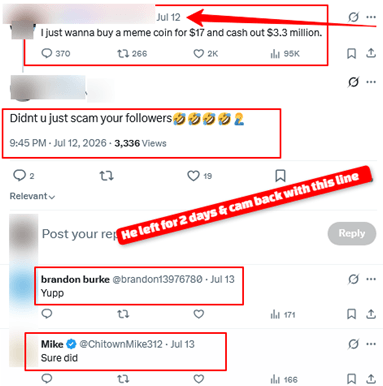
This is how a fake KOL created a rugged token called Roar – an under 18 or so and was pretending like nothing happened after the rug poll.
I hope you are enjoying the journey so far. 🤤
Crypto Community Slang
Now we get into the language you’ll see constantly in crypto communities.
43. WAGMI
WAGMI means: We’re All Gonna Make It.
It’s an optimistic community phrase.
Real Example – The market crashes.
Someone posts: “Stay strong. WAGMI.” They’re encouraging the community to remain optimistic.
44. NGMI
NGMI means: Not Gonna Make It.
It’s usually used jokingly to describe a questionable decision.
Real Example – Someone buys a token without checking the contract.
Another trader replies: “NGMI.”
Translation: “That’s probably not going to end well.”
45. GM
You will see this a lot in CT. GM means: Good Morning.
It’s one of the simplest and most common crypto greetings.
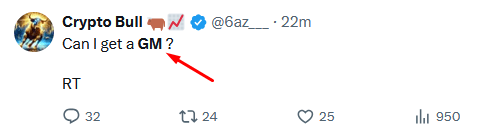
Real Example – “GM everyone. What’s on the watchlist today?”
46. LFG
LFG means: Let’s F*ing Go.**
It’s an expression of excitement.
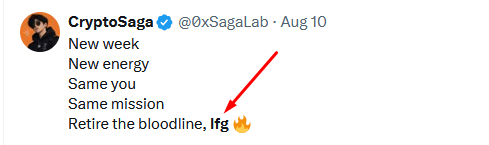
Real Example – Your token breaks a major resistance level. “LFG 🚀”
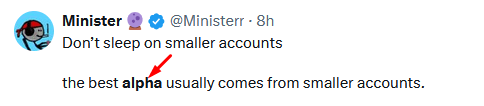
47. Alpha
Alpha means valuable information, insight or an advantage that others may not know about.
Real Example – Someone discovers an interesting project before it becomes widely known.
They might say: “I’ve got some alpha.”
They’re basically saying: “I’ve found information you may want to know.”
But don’t automatically trust something because someone calls it alpha.
Publicly shared “alpha” can simply be marketing or hype.
48. CT
CT means: Crypto Twitter.
It refers to the online crypto community on X, formerly known as Twitter.
Real Example – “CT is going crazy over this Solana memecoin.”
They’re saying the crypto community on X is heavily discussing the token.
49. FUD
FUD means: Fear, Uncertainty and Doubt.
It describes negative information, rumors or criticism that creates fear around a cryptocurrency or project.
Real Example – A rumor spreads that a project’s team is selling tokens.
Someone says: “There’s a lot of FUD around the project.”
But don’t automatically dismiss negative information as FUD.
Sometimes what people call FUD is actually a legitimate warning. Always verify the information.
50. Trust Me, Bro
Trust Me, Bro is a sarcastic response to unsupported investment advice when there I no original source or narrative.
Real Example – “This coin is guaranteed to 100X. Trust me, bro.”
The joke is that the person hasn’t provided evidence.
When someone gives you an investment claim with nothing behind it except: “Trust me.” you probably shouldn’t trust them.

51. HFSP
HFSP means: Have Fun Staying Poor.
It’s a sarcastic phrase sometimes directed at people who criticize crypto or refuse to invest.
Real Example
Someone says: “I’m never buying crypto.”
Another person replies: “HFSP.”
It’s usually used as a joke or insult, not as serious financial analysis.
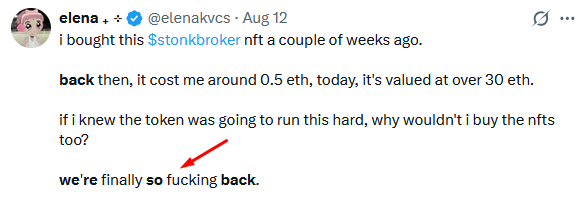
52. We’re So Back / It’s Over
This meme perfectly captures crypto’s emotional roller coaster.
The market pumps: “We’re so back!”
The market crashes: “It’s over.”
Then the market pumps again: “WE’RE SO BACK!”
The joke is how quickly sentiment can change.
Crypto Culture & Meme Terms
Some terms aren’t technical concepts at all. They’re simply part of crypto culture.
53. When Lambo?
When Lambo? is a joke asking when your crypto profits will be large enough to buy a Lamborghini.
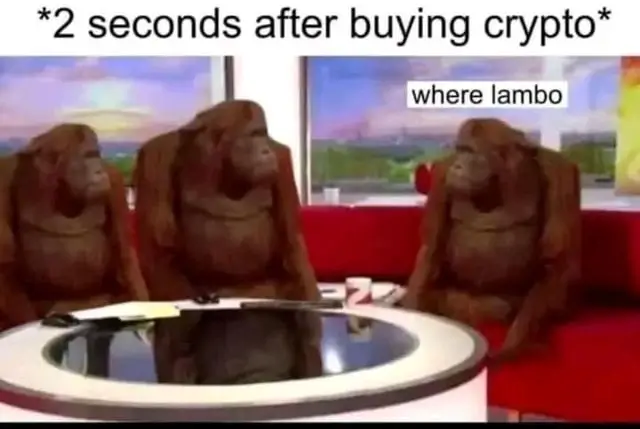
Real Example – Your token pumps 300%.
Someone posts: “When Lambo?”
Translation: “When are we getting rich?”
54. Virgin vs. Chad Investor
Virgin vs. Chad Investor is a meme format comparing two opposite investing behaviors.
For example:
Virgin investor: “I panic sold after a 10% dip.”
Chad investor: “I followed my plan/narrative.”
The meme exaggerates these behaviors for humor.
Don’t treat the meme as actual investment advice.
55. Bogdanoff – Dump It
Bogdanoff – Dump It is a fictional crypto meme based on the idea that mysterious twins secretly control the market.
The joke usually goes something like: Trader buys. Bogdanoff notices. “Dump it.”
The market immediately crashes.
It’s satire, not an actual explanation of market movements.
56. Solana Summer
Solana Summer is a phrase used to describe periods when Solana-based projects, tokens and communities receive significant attention and activity.
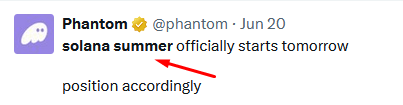
Real Example – “Solana Summer is back.”
A trader may be saying that Solana has once again become a major center of memecoin activity.
57. Funds Are SAFU
Funds Are SAFU is a crypto meme meaning: Funds are safe.
It’s often used humorously or reassuringly during stressful situations.
Real Example – An exchange experiences a temporary issue.
Someone posts: “Don’t worry. Funds are SAFU.”
The phrase itself isn’t proof that funds are actually safe.
58. The Flippening
The Flippening refers to a hypothetical event where another cryptocurrency surpasses Bitcoin in market capitalization.
The term is most commonly used when discussing whether another major cryptocurrency could eventually overtake Bitcoin.
Example – “Could we see the Flippening this cycle?”
They’re discussing a possible change in cryptocurrency market-cap rankings.
59. Laser Eyes Forever
Laser Eyes became a famous Bitcoin meme representing strong conviction in Bitcoin.
Laser Eyes Forever takes that idea further, representing permanent Bitcoin conviction.
You’ll usually encounter it through profile pictures and crypto memes.
Security & Custody Terms
This section is especially important because some crypto terms aren’t just slang, they describe how you protect your assets.
60. Not Your Keys, Not Your Coins
“Not your keys, not your coins” is one of the most important phrases in cryptocurrency.
The idea is simple: If you don’t control the private keys to your cryptocurrency, you don’t have the same direct control over the assets as you would with a self-custodial wallet.
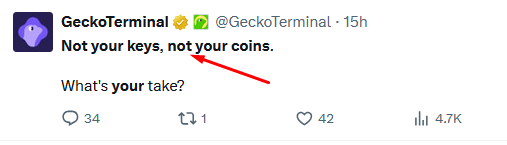
Real Example – You keep your crypto on a centralized exchange.
The exchange controls the wallet infrastructure and private keys associated with your funds.
With a self-custodial wallet [what’s available on Fomop trading App], you control the private keys.
That’s why crypto users say: “Not your keys, not your coins.”
However, self-custody comes with responsibility.
If you control your own private keys and lose them, there may be no company that can recover your assets for you.
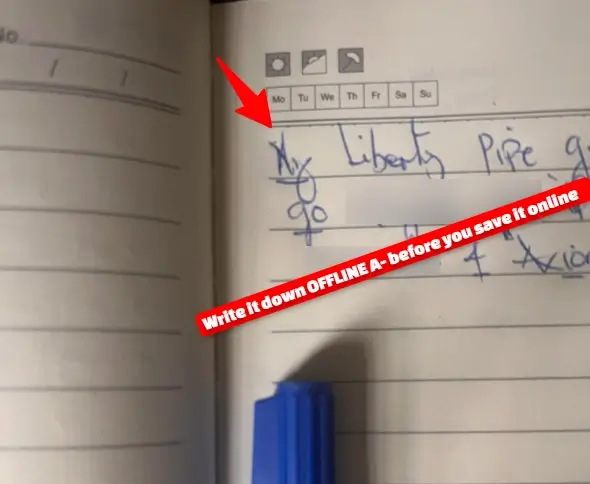
So never share your private key or seed phrase with anyone.
61. KOL
KOL stands for Key Opinion Leader. A crypto KOL is a trusted online voice, analyst, or creator on social platforms like X (Twitter), YouTube, or Telegram whose audience follows their insight on tokens, market trends, and Web3.
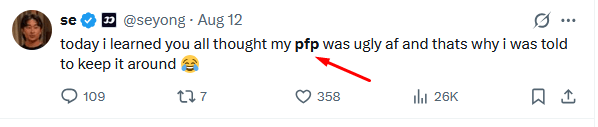
62. PFP
PFP stands for “profile picture”. It refers to a digital art piece-usually a non-fungible token (NFT)-used as an avatar on social media platforms like X.
Yep. That is, it. A grand job every Memecoin trading terms in English language so you can understand it.
Why Understanding Memecoin Trading Terms Matters
At first, crypto slang can seem like nothing more than memes.
But some of these terms describe things you genuinely need to understand before trading.
For example, knowing what liquidity means can help you understand why a token with a large market cap may still be difficult to sell.
Understanding holder distribution can help you recognize when a few wallets control a large portion of a token’s supply.
Knowing what a whale is can help you understand why one wallet’s transaction can dramatically affect a small memecoin.
Understanding a contract address can help you avoid buying a fake token with the same name as the real one.
Knowing what FOMO means can help you recognize when your emotions are influencing an entry.
And understanding a rug pull can make you more cautious when evaluating a brand-new token.
So do not just memorize the words. You want to understand what they’re telling you about the trade.
Memecoin Trading Terms Pdf
Master the Memecoin Trading Lingo
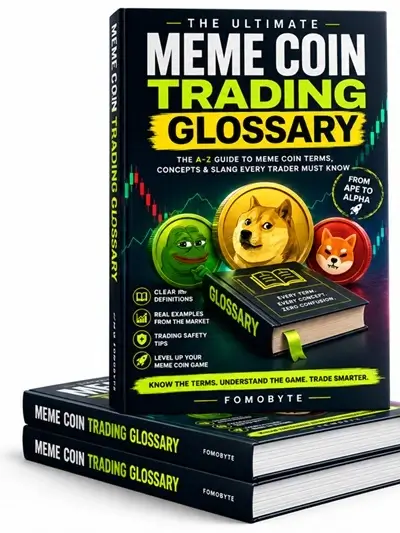
Want to own the memecoin trading terms; liquidity, slippage, market cap, PNL, rug pull, and FOMO? Get the Memecoin Trading Terms PDF and learn the essential slang and concepts you need to navigate the trenches with confidence.
Enter your email below to get your free copy instantly.